If your restaurant only has a Facebook page, you are making it harder for customers to find the information they need. You may have your hours posted, a few food photos, and even a menu somewhere on your page, but that does not mean your online presence is working as well as it should.
This is the real problem in the debate around a restaurant website vs Facebook page. Facebook can help people keep up with your business, but it is not a complete online home for your restaurant. It is not the best place to rely on for menu visibility, clear business information, or helping new customers make a quick decision.
If you want more people to find your restaurant, trust your business, and choose you faster, you need more than a social page. You need a real restaurant website that gives both Google and customers exactly what they are looking for.
Facebook Is Helpful, But It Is Not Enough
There was a time when having a Facebook page felt like enough for many local restaurants. You could post an update, share a photo of the daily special, and let customers know what was going on.
Today, that is not how most people make dining decisions.
When someone is hungry and searching for a place to eat, they usually want quick answers. They want to know:
what kind of food you serve
whether you are open
where you are located
what your food looks like
how to view your menu without extra steps
That is where Facebook starts to fall short.
A Facebook page can still support your business, but it often puts important information behind too many clicks, mixes business details with casual posts, and does not give your restaurant the same kind of clear, organized online presence that a website does.
The Problem With Relying on Facebook for Your Restaurant
Let’s break down what usually goes wrong when Facebook is the main place customers are sent.
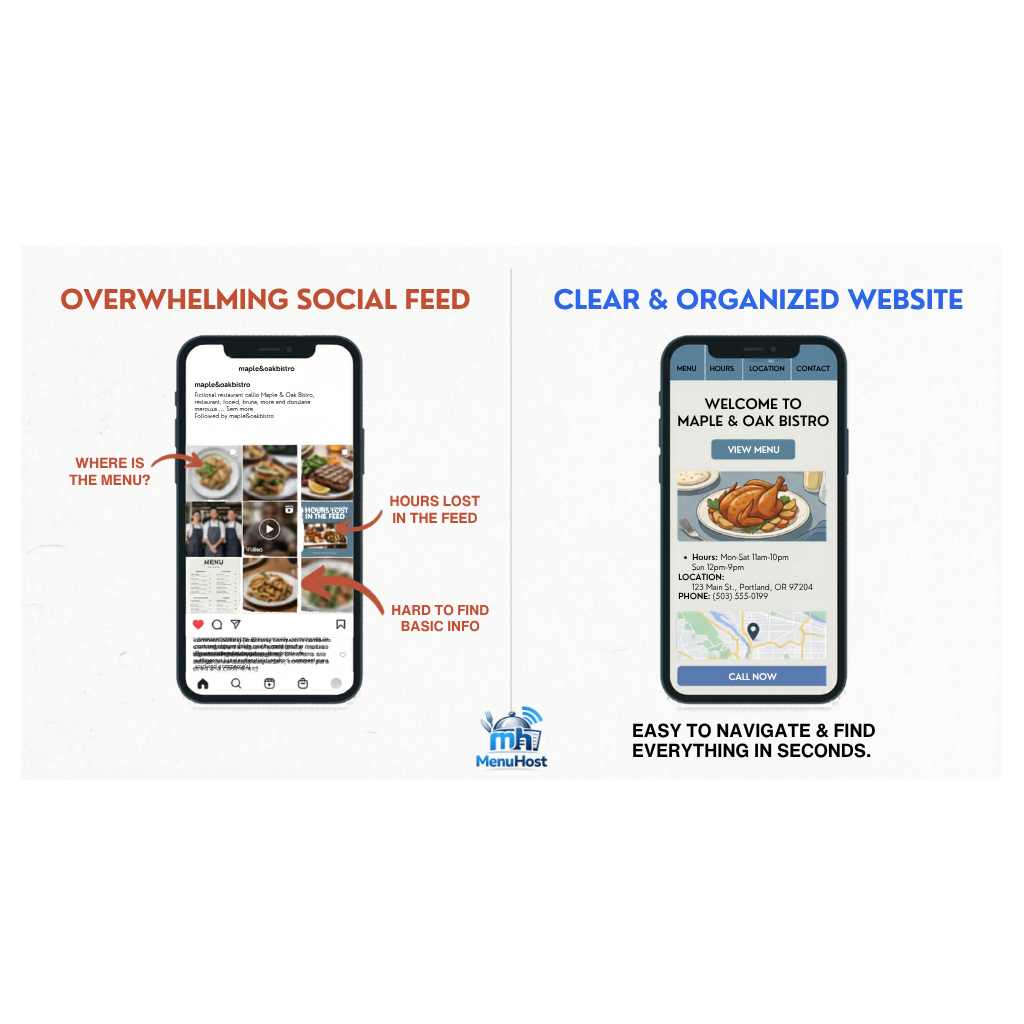
Your Menu Is Harder to Find Than It Should Be
For most restaurants, the menu is one of the first things people want to see.
On Facebook, the menu might be:
buried in a tab
uploaded as a photo that is hard to read on a phone
attached as a PDF that takes extra steps to open
posted weeks ago in the timeline where customers have to scroll to find it
That creates friction. And when people are deciding where to eat, friction costs you attention fast.
An online menu for a restaurant should be easy to find, easy to read, and easy to browse on mobile. If someone has to hunt for it, there is a good chance they move on to a place that made it simpler.
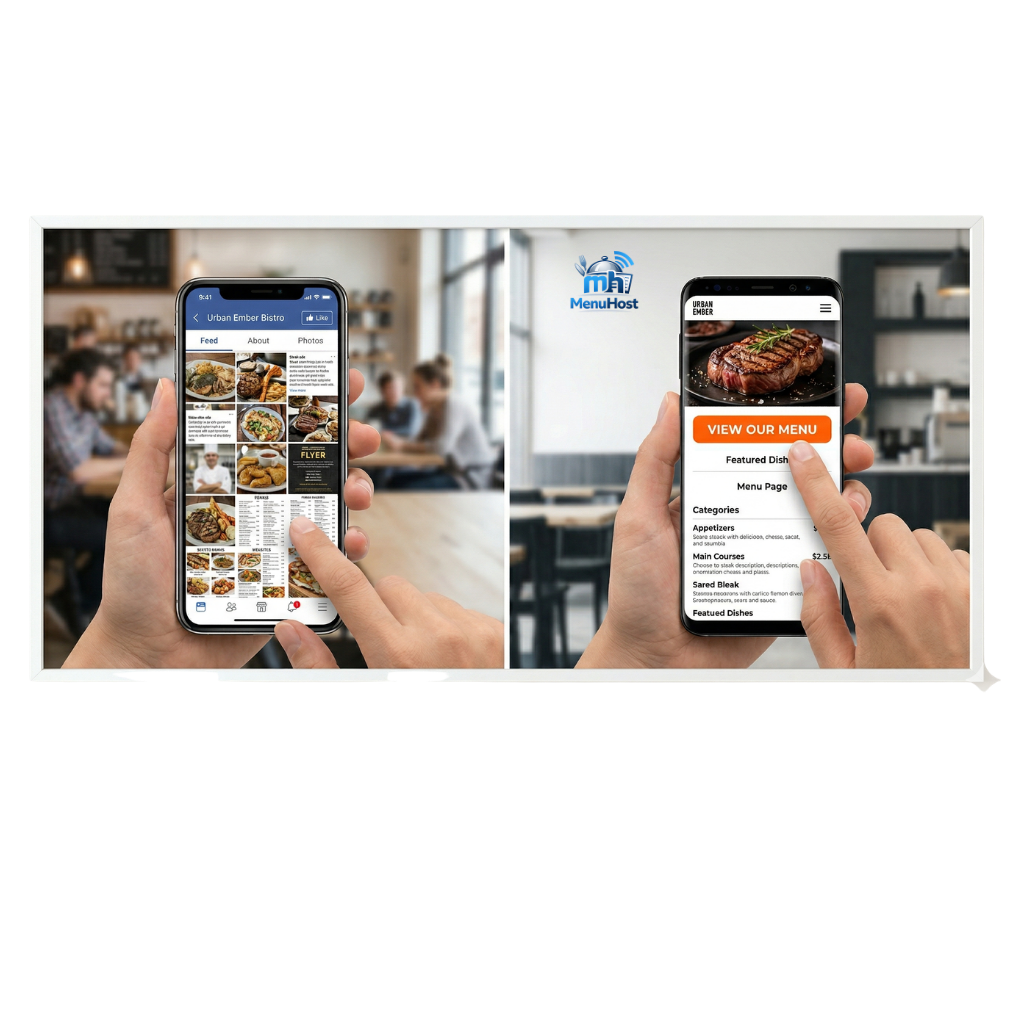
Your Hours Are Easy to Miss
Hours are one of the most important pieces of information a customer looks for.
If your hours are outdated, buried, or unclear, people may not take the risk of showing up. Even if you have them listed somewhere on Facebook, they are not always presented in the cleanest or most obvious way.
A proper restaurant website gives your hours a stable, visible place so customers do not have to guess whether you are open.
Not Everyone Wants To Use Facebook
Some people do not use Facebook often. Some do not use it at all. Others may click through from search and run into a messy viewing experience, especially on mobile.
Even when a page is technically visible, Facebook still adds extra distractions that a website does not. Instead of giving people one clean experience focused on your restaurant, they are dropped into a social platform filled with tabs, posts, buttons, and unrelated activity.
That is not ideal when someone just wants to find your menu and decide where to eat.
You Do Not Fully Control the Experience
When Facebook is your main online presence, you are presenting your business inside someone else’s platform.
That means:
the layout is not built around your restaurant
older posts can compete with your most important information
reviews, comments, and random page activity can shape the first impression
your menu, hours, and photos are not always the center of attention
Your restaurant deserves a cleaner experience than that.
A website gives you much more control over how your business is presented. You decide what people see first. You decide how your menu is displayed. You decide how quickly a customer can go from “I’m hungry” to “Let’s go here.”
A Facebook Page Is Not the Same as a Website for Google
This is one of the biggest reasons why restaurants need a website.
Facebook can help people discover your business, but it does not give Google the same clear, organized website content that a dedicated site does. When your menu, hours, location, and photos live on your own website, it is much easier for both customers and search engines to understand your business.
That matters because restaurant decisions often start with search. If someone looks for a seafood spot, diner, brunch place, or local cafe near them, your online presence needs to clearly support that search journey. A website helps do that in a much stronger way than a Facebook page alone.
Why Restaurants Need a Website: What You Actually Gain
A website is not just a more polished version of social media. It does a different job.
You Give Customers One Clear Place To Go
A website brings the essentials together in one place:
your menu
your hours
your location
your phone number
your photos
your contact information
your PDF menu, if you want to offer one
That matters because most customers are not looking for a full brand experience. They are trying to answer simple questions quickly. A website helps them do that without confusion.
You Help Customers Decide Faster
People make restaurant decisions quickly. They compare options, look at a few menus, check who is open, glance at photos, and choose the place that feels easiest and most reliable.
When your information is clear, current, and easy to browse, you remove hesitation.
That is one of the biggest advantages in the restaurant website vs Facebook page conversation. A website helps turn curiosity into action faster.
You Look More Established and Trustworthy
Whether you run a diner, seafood restaurant, cafe, or family-owned neighborhood spot, first impressions matter online.
A clean website signals that your business is active, professional, and easy to trust. It shows customers that you care enough to make important information easy to access.
That does not mean your website needs to be fancy. It just needs to be clear, useful, and complete.
You Create a Better Experience for Google and Customers
This is where MenuHost’s positioning is especially strong.
Your website should not just “exist.” It should give both Google and customers what they need in one place.
Customers need:
menu access
clear hours
photos
address and contact info
quick answers
Google needs:
organized business information
readable page content
clear signals about what your restaurant offers
a consistent place to understand your business online
A good restaurant website supports both.
You Own Your Online Presence
Social platforms change. Layouts change. features change. Visibility changes.
Your website is different. It is your space. Your information lives there in a format you control.
That gives you a more stable foundation for your business, especially if you want to keep your menu updated, make seasonal changes, add new photos, or send people to one reliable destination from Google, social media, and anywhere else online.
What a Restaurant Website Should Include
A great website does not need to be complicated. It just needs to cover the basics well.
Here is what every restaurant website should include.
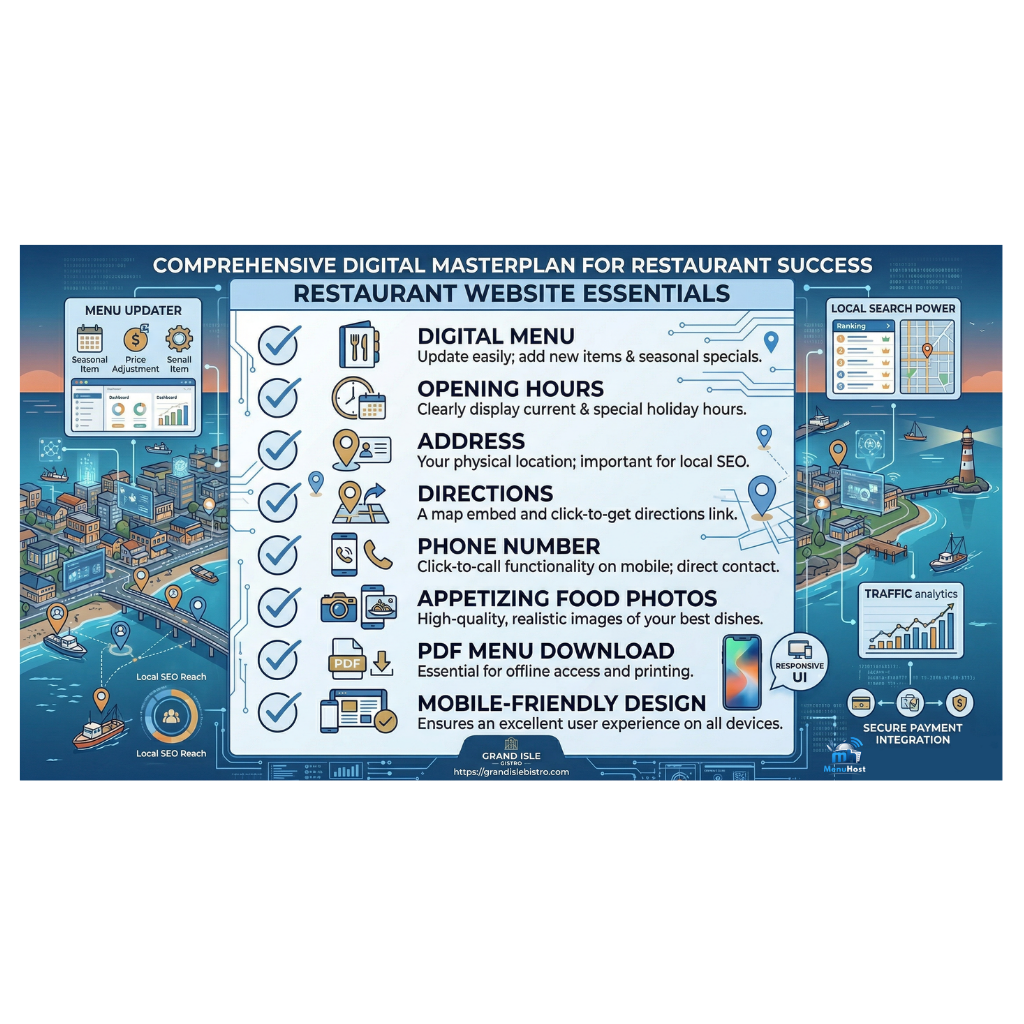
1. A Full Menu
Your menu should be easy to read and easy to find.
That means:
no digging through social posts
no tiny unreadable screenshots
no confusing file names
no guessing whether the menu is current
If possible, your main menu should live directly on the website in a simple, mobile-friendly format. A PDF can still be helpful as a bonus, but it should not be the only way customers can view what you serve.
2. Clear Hours
Your hours should be obvious.
Put them somewhere visible and make sure they stay current. If you have special holiday hours or seasonal shifts, your website should make that easy to update.
This is one of the most overlooked restaurant website basics, but it has a big effect on customer trust.
3. Your Address and Directions
Make your location easy to find.
That includes:
your full address
a tap-to-open map link
nearby location context if needed
easy mobile access for customers on the go
If someone decides they want to visit, they should be able to get directions in seconds.
4. A Clickable Phone Number
Some customers still want to call. Maybe they have a question, want to confirm hours, or need to ask about a large party.
Do not make them copy and paste your number. Make it clickable on mobile.
5. Photos of Your Food and Space
Photos help people picture the experience.
You do not need a huge gallery. You just need enough to help customers understand what your food looks like and what kind of atmosphere to expect.
Good, clear photos make your restaurant feel more real and more inviting.
6. A PDF Menu Option
A downloadable PDF can still be useful.
Some customers like to send a menu to friends, save it, or review it later. A PDF version works well as an extra option, especially if your main menu is also displayed clearly on the page.
7. A Clean Mobile Experience
A lot of restaurant traffic comes from phones.
If your site is hard to read on mobile, slow to load, or cluttered, it creates the same kind of friction customers run into on Facebook.
Your website should feel simple and easy on a phone first.
How MenuHost Helps Restaurants Get Online Faster
MenuHost is built for restaurants that want a simple, affordable website without overcomplicating the process.
Instead of trying to piece together your online presence across random platforms, MenuHost gives you one clean place for the information people are actually looking for:
menu
hours
photos
location
contact information
PDF menu access
That means your site can do the job it is supposed to do. It helps customers decide faster, and it gives Google a clearer understanding of your business online.
MenuHost is especially useful for restaurant owners who do not want to hire a web designer, learn a complicated system, or waste time building pages that include features they do not even need.
It keeps the focus where it should be: making your restaurant easier to find, easier to trust, and easier to choose.
The Bottom Line on Restaurant Website vs Facebook Page
Facebook can still be a useful marketing tool. It is a good place to post updates, share photos, and stay connected with existing customers.
But it is not a complete online home for your business.
A Facebook page is not the best place to rely on for your menu, hours, photos, location, and customer decision-making. It creates too many chances for confusion, delay, and missed opportunities.
A dedicated restaurant website gives your business something better:
one clear place for your most important information
a stronger experience for customers
a better foundation for Google visibility
more control over how your business shows up online
If you have been relying on Facebook alone, this is one of the smartest upgrades you can make.
Ready To Give Your Restaurant a Real Home Online?
If customers still have to dig through Facebook to find your menu, hours, photos, and location, it is time to make things easier.
Give them one clean place to find what they need. Give Google a better way to understand your restaurant. And give your business a stronger online foundation.
Build Your Restaurant Website with MenuHost